Posts
Posts Twitter
 Delicious

This is sad. Two years old, (two years!) and smoking forty cigarettes a day.
I'm dumbfounded.
2010-05-28
Two Years Old on Two Packs a Day

2010-05-27
Book Giveaway: "Delivering Happiness" by Tony Hsieh

Now I'm probably like most of you guys in that I had only used Zappo's once before, and had honestly never heard of Tony Hsieh. In short, I didn't know what to expect from the book.
Well I read it over the weekend , and I have to say that it made a lifelong Zappo's customer out of me. In fact I almost bought a pair of shoes yesterday just because I liked the book so much. Andrea just laughed at me as I went on and on about this guy.
Anyways, I'm legally required to wait until June 7th for an actual review, so for now here's a couple reviews from famous people to further pique your interest:
–Tim Ferriss, Author of The 4-Hour Workweek
Tony Hsieh has done a huge amount of thinking about how to bring happiness to himself, to employees, and to customers, and in this fascinating (and often hilarious) account, he explains how he turns his beliefs into actions that really do deliver happiness.
–Anthony Robbins, Author of Unlimited Power and Awaken the Giant Within
Delivering Happiness is a glimpse into the mind of one of the most remarkable business leaders of our time. Like its author, the book is authentic, oddly original, doesn’t take itself too seriously—yet delivers a potent message. Weaving together history, personal philosophy, and insights from one of the most intriguing companies in world, Delivering Happiness works on the mind, the heart, and the soul. This book needs to be read by anyone who takes the happiness of other people seriously.
How to Win a Free Copy (w/ free shipping)*
(contest is now closed)
(contest is now closed)
1. Leave a comment stating why I should send you the book no later than midnight June 6th (as many as you want).
2. Be sure to include some way for me to contact you.
That's it! I'll pick a # at random and that person will be notified on June 7th of their winnings. This blog averages 1 comment per post so the odds of winning are EXTREMELY high. So to the four of you who actually leave comments, I say good luck!
![Reblog this post [with Zemanta]](http://img.zemanta.com/reblog_e.png?x-id=7370e0df-2e75-4a98-a1d3-569ccea920e5)
2010-05-24
Death Creates An Economy That Makes Life Precious
Came across an interview with Stanley Hauerwas, one of my brother-in-law's former professors at Duke Divinity School, on the subject of how his Christian faith had shaped his view of death.
The above quote might be one of the most beautiful phrases I've heard on this subject, and is the reason I posted it here. However equally as intriguing is his mention of the the phrase "save us from a sudden death" in the Book of Common Prayer, and how that differs from the modern desire to die in such a way that we avoid any knowledge of our death.
Hauerwas postulates a shift towards fearing death over fearing God, and ends the video with his view on what "a good death" looks like. Good stuff.
Reflections on Death from CPX on Vimeo.
![Reblog this post [with Zemanta]](http://img.zemanta.com/reblog_e.png?x-id=0df9530c-288f-4320-b5f6-c9e5bb449c6b)
2010-05-20
Evening Links
Consumer credit making a comeback?
Unemployment and the Battle of the Sexes (h/t wonkbook)
Edward Glaeser on the the climate bill and the case for a carbon tax.
Election season: In China?:
For the voters, electing the Party secretary is like "selecting products they favor in the supermarket", said Chen Jian, a township government official, who was sent by Yongning to take part in the election of Houchong. "We candidates stand on the stage for them to compare and choose."So thaaaat's how it works.
Did He Just Drop the P-Bomb?
I couldn't help it. This is gold. But also somewhat inappropriate, so be warned.
The reaction of the other two newscaster is classic, as is the perpetrator's complete unawareness of what he just said.
Am I wrong?
Federal Debt is Gross
Very interesting chart that Barry Ritholtz posts on the Big Picture:
a few things to note:
1. TR once again outdoes his peers, as he does in almost all metrics of awesomeness.
2. The gross federal debt is high, and needs to be addressed, but it's not unprecedented.
3. Reagan...
I Was Wrong and I Apologize
Back in November 2008 I made a very very bad prediction. On a whim, I posted my thoughts regarding the direction of a certain man's career and his ability to improve (or not) upon his predecessor. Thoughts that, as it turns out, could not have been further from the truth.
I am of course talking about Jimmy Fallon taking over Late Night from Conan O'Brien.
Now don't get me wrong, NBC completely screwed the pooch by giving The Tonight Show back to Jay Leno, but the one thing they did right was to give "Late Night" to Jimmy Fallon. Yes his monologue seems forced at times, but they make up for this by keeping it short and relying more on Jimmy's roots in sketch comedy (along with a healthy dose of The Roots) to carry the day.
A point which is perhaps best illustrated by the following sketch:
You can thank me later.
![Reblog this post [with Zemanta]](http://img.zemanta.com/reblog_e.png?x-id=48aa375e-3758-49ee-b064-dbd2f3b493b1)
Thailand is Fairing Better than you Think
.jpg) The truly wild thing about the uproar in Thailand is not the fact that protesters brought the city to a standstill in an attempt to force the government to resign (that's happened before), or that its capitol city and surrounding areas are under curfew after yesterday's rioting, or that several buildings were set on fire by the opposition in response to military force.
The truly wild thing about the uproar in Thailand is not the fact that protesters brought the city to a standstill in an attempt to force the government to resign (that's happened before), or that its capitol city and surrounding areas are under curfew after yesterday's rioting, or that several buildings were set on fire by the opposition in response to military force.
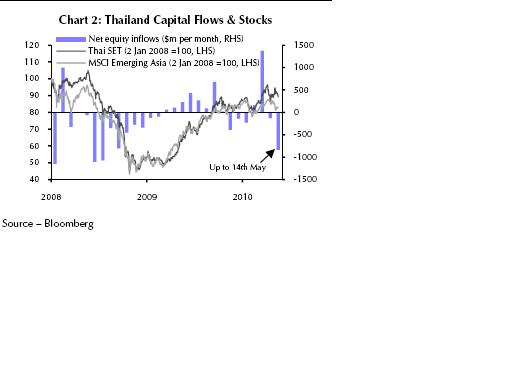
The really unbelievable thing is that through all of that the Thai economy is actually fairing pretty well. Seriously, one of those burning buildings in the papers this morning was the Stock Exchange of Thailand, which happens to still be up on the year and actually outperforming other emerging countries. How can that be? According to a report by Standard Chartered Bank, it's because the markets have already priced in the the disruption.
Talk about political risk analysis. Markets have already priced in the fact that thousands of protesters would besiege Bangkok for weeks, all but shutting down the city and crippling the tourism industry. I don't know if this speaks more to the overall soundness of the Thai economy or to the fact that political unrest is so common in Thailand that the markets have basically stopped noticing. In reality it is probably a bit of both.
To be fair, the Thai government has announced that it is reducing its economic growth forecast for the year because of the disruption (after having recently revised it upward!), but it seems as though the political volatility would have bled through in the form of greater market volatility. It's also true that Thailand has set itself on firm economic footing over the past ten years by building up a large stockpile of foreign exchange reserves and a strong current account surplus, among other economic cushions. All these things combined have analysts actually predicting a rise in the Thai stock market and an appreciation of the Thai baht against the U.S. dollar.
Surely no one would be making such sanguine predictions if this were happening in other emerging markets. If this was Beijing instead of Bangkok, global markets would be having even greater fits than they are now. Of course there is a size difference in the economies in terms of global presence. But it's still astonishing. Essentially what has happened is that Thailand has turned a sustained level of political instability into business as usual, and paradoxically reassured investors that there is no need to panic.
Life on Earth
Astonishing announcement today from the scientific community:
Scientists have turned inanimate chemicals into a living organism in an experiment that raises profound questions about the essence of life.
Craig Venter, the US genomics pioneer, announced on Thursday that scientists at his laboratories in Maryland and California had succeeded in their 15-year project to make the world’s first “synthetic cells” – bacteria called Mycoplasma mycoides.
Synthetic life. The possibilities seem immense, as do the potential abuses. I'll admit I'm a mugwump on the on morality side of this development (and, yes, I'll also admit I just learned the word mugwump a few days ago and have been looking for an opportunity to use it -- sue me), but this seems like an interesting application:
They are particularly interested in designing algae that can capture carbon dioxide from the air and produce hydrocarbon fuels.
Last year Synthetic Genomics signed a $600m agreement with Exxon Mobil to make algal biofuels. “We have looked hard at natural algae and we can’t find one that can make the fuels we want on the scales we need,” Dr Venter said.
What's the Deal with Capital Requirements?
The Senate is attempting to close the debate on financial regulation again today after yesterday's botched cloture vote due to a couple of Democratic defections and near-unanimous Republican descent. Word is the newest Republican maverick, Scott Brown, might change his mind and not vote to filibuster, but that still leaves the Dems one vote short, assuming Arlen Specter decides to bother coming back to Washington after his primary defeat on Tuesday.
Ok, great -- the Senate might pass it's version of the bill this week. But the story is still far from over on what the legislative sausage factory will produce, especially after the House and Senate bills go through reconciliation (it's not just for healthcare anymore!). That's one reason that some analysts are saying the Senate shouldn't be in such a hurry to close this debate.
One of the most contentious aspects of the bill as it now stands involves the issue of capital requirements for the banks -- how much money (or other various assets) they have to hold in order to ensure that they can pay back their lenders and cover their losses. An amendment proposed by Sen. Susan Collins (R-Maine) is at the center of this argument. Her change was unanimously passed last week, but only recently did it start to garner much attention, and it's many critics now include the Treasury, the Federal Reserve, and Wall Street:
"I don't believe that the senators understood the full implications of this amendment," said Edward Yingling, chief executive of the American Bankers Association trade group. "It would cause a severe capital crunch for many banks, resulting in the major decrease in lending capability."
U.S. and foreign bank regulators are working to complete new international capital requirements by the end of this year, and Treasury Department Secretary Timothy Geithner has made it one of his top goals. Sen. Collins's provision could affect those discussions by creating a new federal law mandating capital standards.
First, the banks' mantra that any and all financial regulation will "result in a major decrease in lending" is getting tiresome. It's true that right now the U.S. needs better, smoother credit flows, but once the economy is comfortably back on its feet, credit availability should be kept in check. That's the whole point of regulation -- remember excessively low interest rates and easy credit were a major factor in creating the financial mess in the first place. So claiming now that higher capital requirements will hurt banks' ability to lend is disingenuous. Although it might be an argument for phasing in higher capital requirements slowly.
This really seems to come down to a battle between the FDIC and the Treasury and the Fed about who will be in charge of setting and overseeing bank capital requirements. The latter institutions want more flexibility in determining these regulations both domestically and internationally. Recent events have shown that unilateral regulatory decisions can create havoc in the markets. Still, most observers have been saying for months that stricter capital requirements on the banks is one of the few no-brainers when it comes to financial reform. Demanding higher capital requirements now, but phasing them in once the economy is stronger might be the best solution because after the upswing takes hold, enacting solid and sensible reforms will only get harder. Plus, at least for now, if Wall Street is really pushing against it, you have to assume it's good.
Subscribe to:
Posts (Atom)